
Improving suicide care requires strong systems, shared accountability, and seamless transitions across care settings, especially during moments of elevated risk. Through the 2025 Suicide Care in Healthcare Quality Improvement Initiative, Vermont healthcare and community partners are working together to strengthen suicide care pathways using evidence-informed practices, data, and quality improvement methods.
Facilitated by the Vermont Program for Quality in Health Care and funded by the Vermont Department of Health and the Vermont Department of Mental Health, the initiative supports teams in improving continuity of care, particularly during transitions from emergency departments to community-based services.
The work underway in Vermont’s Northeast Kingdom offers a strong example of this approach in action. Building on long-standing partnerships, local hospital and community organizations came together to formalize a Safe Transitions Team focused on coordinated, sustainable suicide care. The story below highlights how collaboration, data, and flexibility helped strengthen care transitions and improve support for individuals at risk.
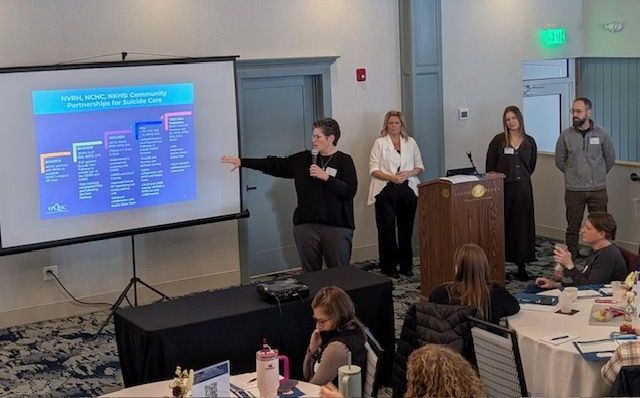
Author: Andrea Willey, LICSW, Northeastern Vermont Regional Hospital Community Health Team.
Rural communities face unique challenges in suicide prevention, particularly during transitions from emergency department (ED) care to community-based services. Individuals experiencing suicidal crises are at elevated risk during these transitions due to fragmented systems, limited behavioral health access, and inconsistent follow-up. In Vermont’s Northeast Kingdom, community partners identified a critical need for a coordinated, evidence informed approach to improve continuity of care for individuals at risk for suicide following ED visits.
For years,
Northeastern Vermont Regional Hospital (NVRH),
Northern Counties Health Care (NCHC), and
Northeast Kingdom Human Services (NKHS) have collaborated to strengthen suicide care across hospital and community settings. Building on these trusted relationships, partners formalized a Safe Transitions Team focused on ensuring individuals at risk for suicide experience consistent, supportive, and connected care following emergency department encounters.
Through the
2025 Suicide Care in Healthcare Quality Improvement (QI) Initiative – a grant opportunity funded by the Vermont Departments of Health and Mental Health and facilitated by Vermont Program for Quality in Health Care – the team leveraged previous grant cycle progress and collaborated on the use of the Stanley Brown Safety Plan across emergency and community-based settings. This collaboration focused on Electronic Medical Record (EMR) integration of the Stanley Brown Safety Plan and the development of a standardized warm handoff pathway. Emergency department clinicians, NKHS Emergency Service team members, behavioral health specialists, peer support workers, and clinical care coordinators worked together to ensure safety plans followed patients beyond the ED and into the community.
Quality improvement efforts were guided by a combination of Results-Based Accountability (RBA) and Plan-Do-Study-Act (PDSA) frameworks. Rather than creating new systems, partners aligned suicide prevention work with existing workflows, meetings, and quality initiatives, allowing the work to scale sustainably across settings.
Outcomes and Impact
Short-Term Outcomes
• Standardized safety planning implemented across ED and community partners
• Increased use of warm handoffs from the ED to community Providers including behavioral health services
• Improved communication and shared workflows across organizations
Intermediate Outcomes
• Greater continuity of care following ED visits for suicide risk
• Increased engagement with outpatient and community-based supports
• Improved staff confidence and shared ownership of suicide prevention efforts
Long-Term Outcomes
• Strengthened community-wide suicide prevention infrastructure
• Sustainable, data-informed care transition practices embedded into routine operations
Lessons Learned
• Progress over perfection: Starting with existing resources builds momentum and trust
• Data and evidence strengthen decision-making and partner alignment
• Flexibility is essential when working across organizations with different cultures and capacities
• Champions who bridge hospital and community systems are critical to success
Next Steps
Partners will continue tracking warm handoff utilization and readmission data to guide quality improvement. We will collectively, across systems, continue to work on innovative ways to measure and upskill staff confidence related to caring for those with elevated suicide risk. Future efforts will focus on expanding training, strengthening peer support and community health worker integration, and aligning suicide prevention work with additional quality and population health initiatives currently underway in the rural Northeast Kingdom.
Summary
By leaning in on long-standing partnerships, evidence-based practices, and shared commitment to accountability, rural communities in Vermont’s Northeast Kingdom strengthened suicide care transitions. The Team took a scaffolding approach to sustainable and coordinated suicide prevention. The model demonstrates how system relationships, collaboration, data, and flexibility can improve outcomes for individuals at risk during critical moments of care transitions. Rather than introduce new systems, the approach emphasizes coordination, where feasible, between community-based and hospital-based efforts, supported by a point of contact whose aim was to align activities across settings. Designed with flexibility, and based on local capacity, priorities and readiness, this pathway could be leveraged for potential replication across other rural communities in Vermont.
More Resources: